
The First Flying Machine just might Open Up the Solar System
The first in a series introducing a groundbreaking spacecraft concept: S.H.E.P. - Secure Handling through Encapsulated Pneumatics

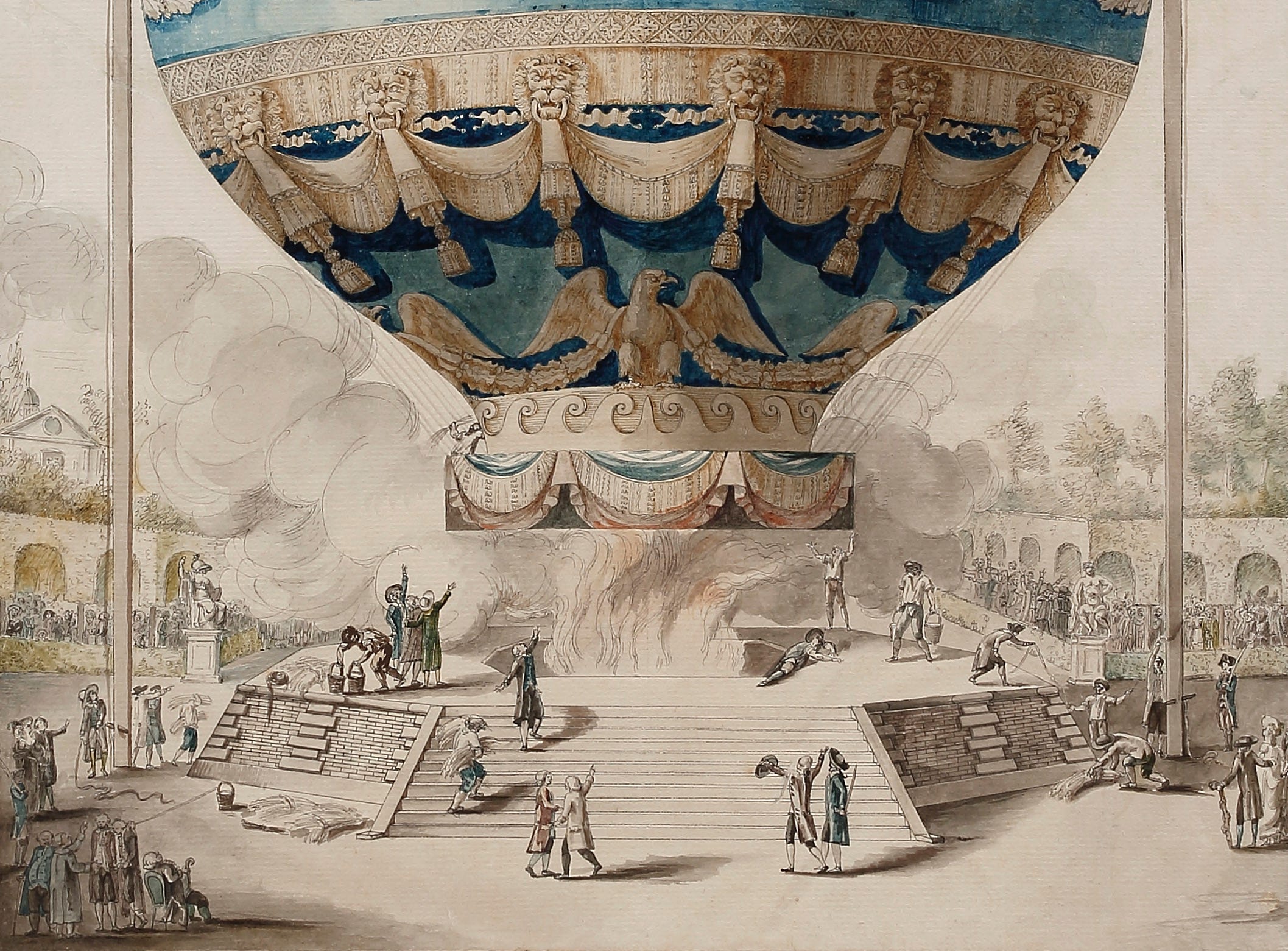
Watercolor of the first hot air balloon flight by the Montgolfier brothers, attributed to Claude-Louis Desrais (Annonay, France 1783)
In 1783, when the Montgolfier brothers set forth near Paris in the first hot air balloon the world had not yet captured the power of steam to automate a loom, coiled electrical current to carry light or voices, or moved a mile over land on anything but our own two feet or the good graces of horse’s hooves. And yet, by a seeming miracle, we were suddenly airborne. Carried by wind alone, early balloonists traveled faster and farther and with more breathtaking perspective than any human yet alive. While normal for seagulls, this change of height literally blew peoples’ minds. For the first time the shape of landscapes, the growth of cities, and even the weather was seen from above. This began a form of perspectivism that would reach its pinnacle with the first views of the whole Earth from space in the late 1960s. Seeing our world as a whole was a mind-change that may be the essential next evolutionary step for our survival.
There is one close competitor to the extraordinary overview and speed of balloon rides, and that is the sailing ship. Also powered by air through the force of wind on fabric, sailing ships brought speed, a global perspective and even mast-swinging height thrills for several thousand years before the Montgolfiers. Mariners were always considered a special breed, people who had done things and seen things that put them in a category apart from mere land-lubbers. They were the astronauts, the deep sea divers and the psychedelic far-journeyers of their time.
There are some clues to our future here, and one is very surprising: that it is the force of air which may hold the key to opening up our neighboring Solar System to enable life’s next expansion (and a great new human adventure). Indeed, hot gases ejecting from rocket engine nozzles already lift us to space, and to survive there we have to bring along little biosphere bubbles of breathable air. Yet there is something else we have not seen, until now.
A Budding Young Spacecraft Designer
Recently, Elon Musk has called for making humanity a multiplanetary species and put his entrepreneurial brilliance and leadership muscle behind it with the development of fully reusable launch systems at SpaceX. He has stated that "I think we should spend the vast majority of our resources solving problems on Earth. Like, 99 percent plus of our economy should be dedicated to solving problems on Earth… but I think maybe something like 1 percent, or less than 1 percent, could be applied to extending life beyond Earth."
Back in my teen years, I followed Princeton physicist Gerard O’Neill who questioned whether the surfaces of planets like Mars or our own Moon were the best places for an expanding civilization.
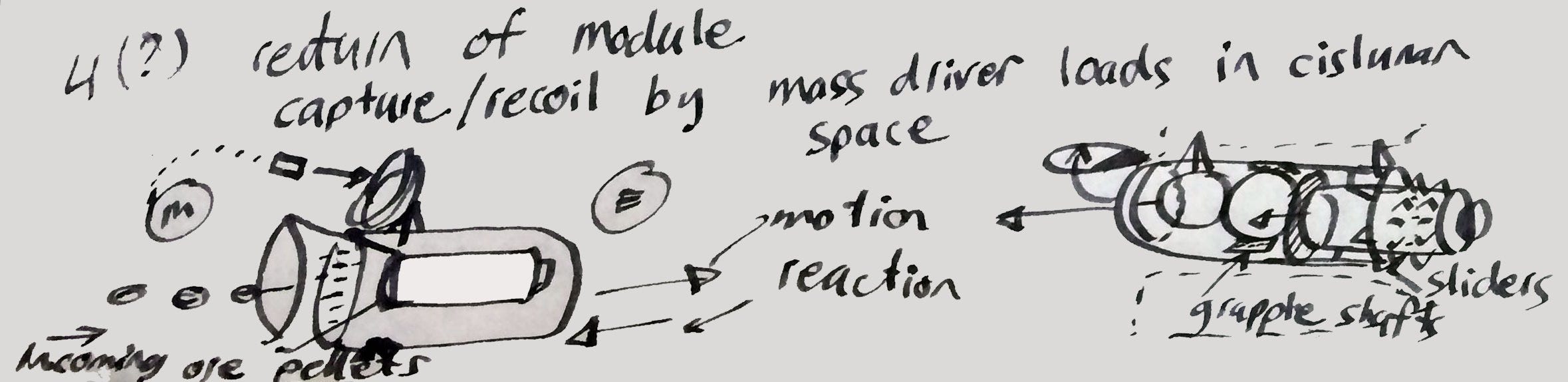
My 1978 budding teenage spacecraft designer sketch of a “mass stream” asteroid propulsion system sent to Gerard O’Neill at the Space Studies Institute in Princeton, NJ. Left: catcher’s mitt for ore pellets, right: grinder/mass driver hurling off the pellets from asteroids.
O’Neill concluded that building large, rotating space colonies was a better bet than settling on planets or moons and formed an organization called the Space Studies Institute which yours truly, a budding teenage spacecraft designer, eagerly joined. I even more eagerly sent off scribbled drawings (above) to O’Neill at SSI. These were notions of how we might mine asteroids and then generate streams of electromagnetically shot-off ore pellets that would be captured in a sort of baseball mitt. This mitt could then use the mass stream of pellets to propel spacecraft on impulsive highways throughout the Solar System. The ore could also be caught for processing to build colonies.
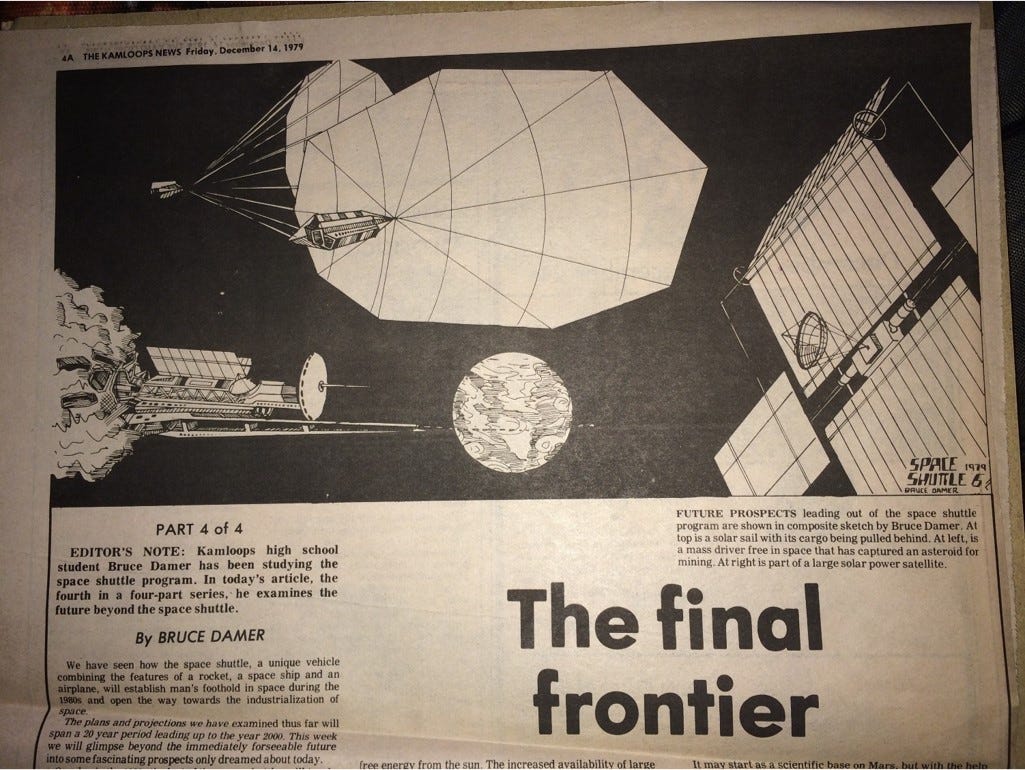
More fully formed concepts from my first newspaper article series in late 1979, lower left: asteroid miner generating a stream of ore pellets hurled off by an electromagnetic mass driver, and upper right: fabric strung solar sails capturing the sun’s proton blast to move cargoes around.
Those early sketches developed into my first newspaper article series as I was finishing high school (concept asteroid miner + mass driver and solar sail above). In a way, the article you are reading today is a 21st Century update on what I started 46 years ago.
Growing up inspired by Apollo’s Saturn V launches and moon landings, I had another epiphany at age 14 to work on the question of the origin of life. I pondered how life could have begun on the early Earth, billions of years ago, and where it might arise on other worlds. Linking this together in my mind at that time was an emergent mission for Humanity to bring life beyond its birth world, to spread rare, complex life forms into the cosmos where evolution could continue to work its magic.
By the late 70s the environmental movement was emphasizing ‘limits to growth’. Walking in our neighborhood of newly built suburbs in the central British Columbia town of Kamloops, I looked out at our expanding city and thought: “this growth is just going to continue as it is a natural drive for humans and other animals to use all available resources”. I was conflicted as it pained me to watch unstoppable bulldozers tear up my beloved sagebrush hills. Despite this insatiable urge, it seemed to me that humans would find pragmatic ways to keep expanding, but along the way work out innovative strategies to preserve a critical mass of original nature and manage our biosphere as a whole. The tickle of a new idea arose: Could it be that the most pragmatic solution to accommodate our insatiable drive would be to find a way for humans to expand into space, bringing life along with us? And would such an expansion require us to build new biospheres and thereby develop the tools and mindset to better manage the original biosphere of Earth?
Joining the Space World
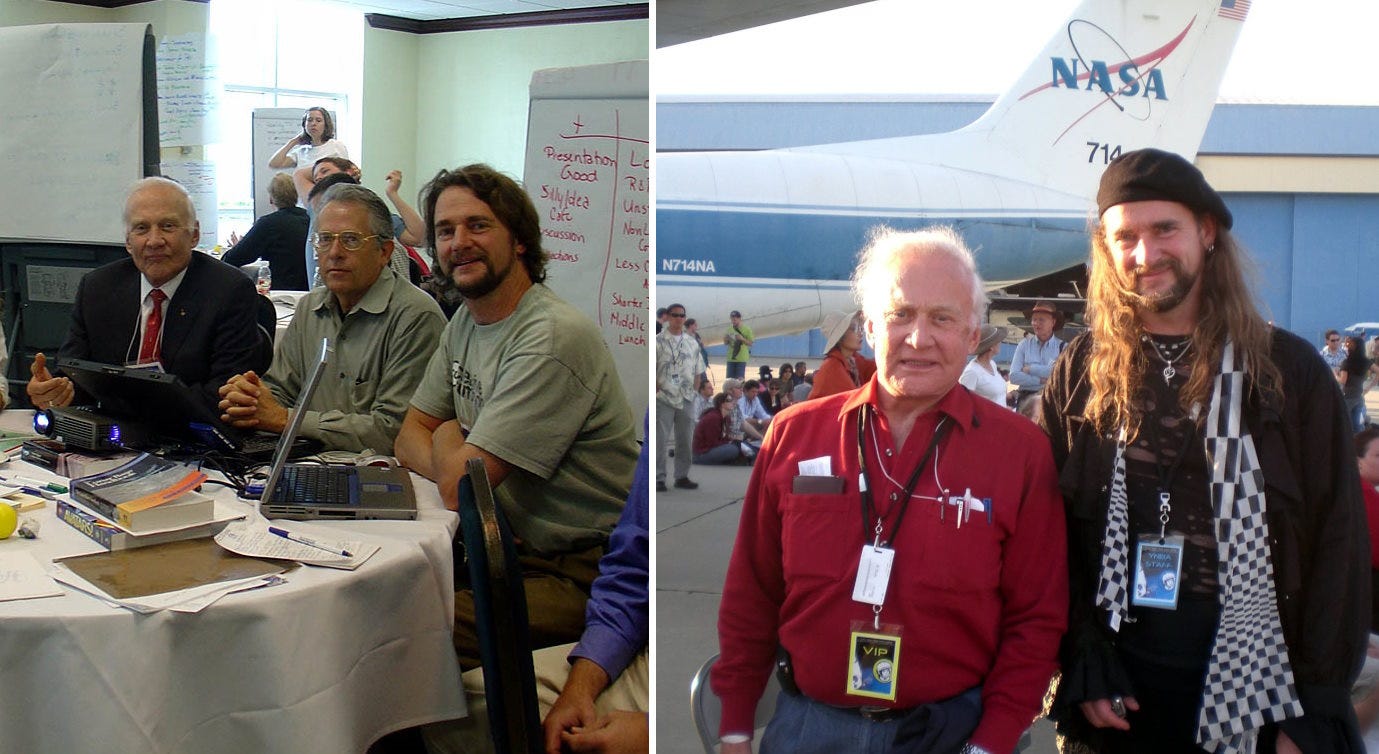
Left: Buzz Aldrin, Tom Cochrane, and yours truly developing lunar base designs for Boeing in 2004. With Buzz at Yuri’s Night on April 12, 2008, NASA Ames Research Center, where we both presented innovative spaceflight architectures.
I met several astronauts in my 20s and 30s, and in my 40s through a series of NASA contracts I worked with some of the astronauts who had been in the Apollo program, notably Buzz Aldrin and Rusty Schweickart. Rusty and many astronauts since had been forever changed by seeing Earth from space. Like the earlier balloonists, they began to see the world as a singular place, and from their lofty vantage point as precious and fragile. This psychological shift came to be known as the ‘overview effect’, a term coined by Frank White. I began to feel that clearly there would be a great value if more people thought and acted this way, benefiting both humanity and our planet’s long term prospects. Along with a drive for discovery and adventure, space drew me into a career and as it had for many others, into a personal transformation to think on planetary scales.
Landing a Rover on Mars
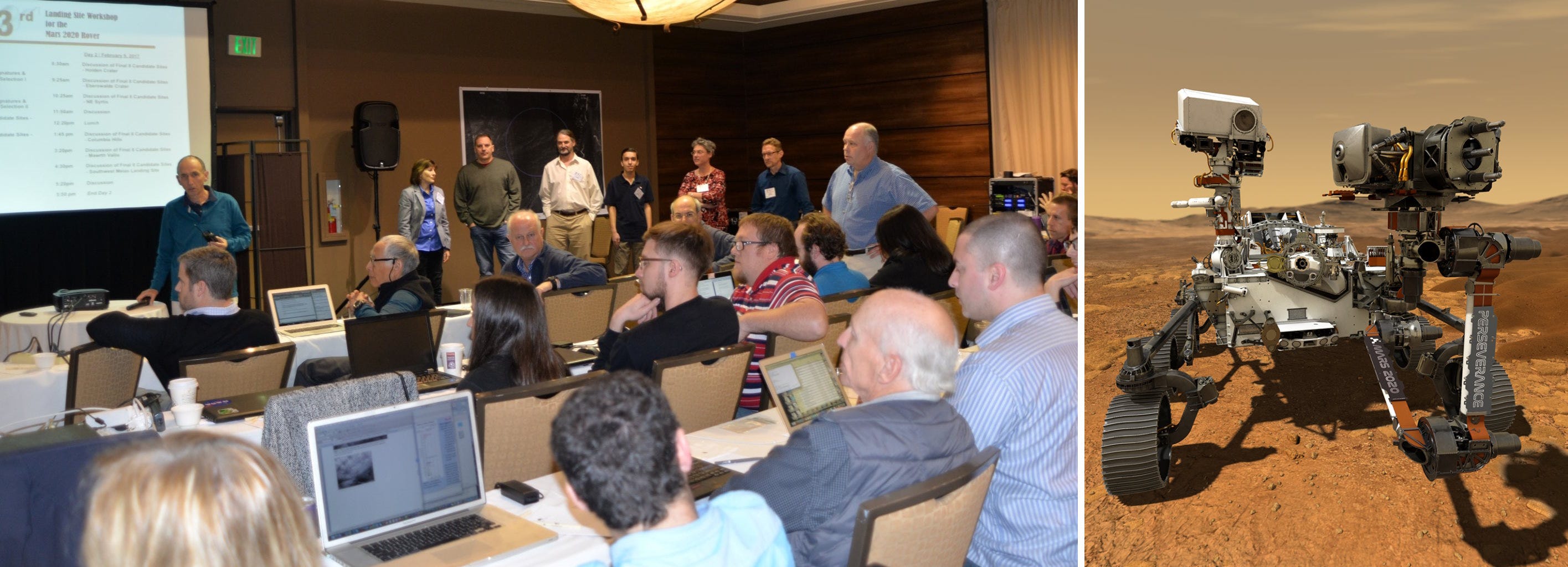
Columbia Hills Team (me in white) presenting our landing site to NASA to 300 scientists, engineers and managers (Photo: Tara Djokic), and the Mars2020/Perseverance rover (Credit: NASA/JPL-Caltech)
My two passions, space and the origin of life, merged perfectly one day in February 2017 when I was a part of the ‘Columbia Hills’ team at the 3rd Mars landing site workshop for the then upcoming Mars2020 (Perseverance) mission. We advocated for NASA’s newest and most capable rover to land where in 2007 a previous rover named Spirit had stumbled upon evidence of an ancient hot spring. As the workshop opened, Dave Deamer and I had been putting forth our new ‘Hot Spring Hypothesis’ for life’s origins and NASA was listening. In front of 300 engineers, scientists and managers, we strove to make the case that if life began in hot springs on Mars, the best preserved evidence for it on the surface would be entombed in these silicate hydrothermal deposits. After all, some of the oldest evidence for life on Earth had been found in 2014 in an exquisitely preserved 3.5 billion year old hot spring in Australia. While our landing site lost out to Jezero Crater, a compelling river delta fed lakebed, whether life ever got going on Mars was being seriously considered, and aspects of that question struck me as quite haunting.
Two Haunting Realities About Life in the Universe (and us)
It turns out that getting life going probably requires rocky worlds with some dry land, some oceans and freshwater precipitation falling and feeding boiling volcanic hot springs. While other scenarios can carry out some of the key prebiotic chemical steps, Charles Darwin himself thought life might have fully gotten assembled in a ‘warm little pond’. In 21st Century science, that notion has been updated to little wet-dry cycling hot spring pools that can serve as ratcheting chemical ‘genesis engines’ to bring the first microbes into being. There is one haunting reality to contend with: that shortly after their formation, most planets pull the rug out from the first life that might have started there. Even if microbes got started on a warm, wet early Mars or Venus, both worlds were fated to change, making life on their surfaces impossible: Mars went cold and dry and Venus got hot and dry. So Martian or Venusian life (if it is there at all) lives in hot, wet rock refuges away from lethal surface conditions. Such life will never get complex, instead living out simple lives until our Sun inflates into a red giant and gobbles up Venus, Mars, and our Earth.
That fate is billions of years out but indicates that our Earth is a really rare planet, with all the conditions to maintain a habitable, watery surface to support life’s evolution. I get the shivers when I ponder all the happenstance events that led to the arising of plants, fungi, animals, and us. There is a second, equally haunting reality: that our precious Earth is close to becoming Venus. In his book A Rough Ride to the Future, James Lovelock calculated that a mere three percent increase in solar radiation falling on Earth’s surface would throw us into a runaway greenhouse effect… and we will become a second Venus. How long in the future is that? Lovelock suggests that in geological time, it is just around the corner, in 100-200 million years, which is a fraction of a percent of Earth’s total remaining lifetime. While that doesn't seem like a reason to sell your retirement fund and book a permanent cruise to nowhere, this virtually guaranteed pending end brings us to a double header of haunting conclusions:
Earth life, including complex, thinking forms like us who can contemplate our own beginnings and plan for our futures is vanishingly rare, precious and deserves our full gratitude and careful stewardship. Despite the number of planets in our galaxy, the distances in time and space between them may mean that we are effectively alone.
Our planet is nearing the end of its ability to support plants and animals on land (and eventually in the seas too). Should we go extinct, there will be nothing to follow us, so we are Earth’s last shot at continuing the grand experiment of complex, thinking life. The future of Earth, and life itself is in our hands.
Clearly we need to realign the impact of our civilization on our world. We are doing that in fits and starts but could work harder and smarter. One motivation is the metaphor that perhaps some time ago mother Gaia handed over the keys to the biosphere to us. She advised “you are my greatest creations, but you are driving the car so fast and furious that evolution can’t adapt, so it’s over to you with your new tools, maps and piloting skills.” So, if we accept the job and take the steering wheel of life’s future evolution we have to know our biosphere more deeply. This responsibility gives gravitas to our lives and perhaps a new sense of meaning and purpose for global civilization.
I hope to convince you that living in space will serve that mission very well. To live in space, we will have to build and nurture new biospheres to feed us, learning to farm and fish among the stars. Biosphere engineering will come to the fore and become a great teacher. As we master the ability to build and nurture new biospheres, we will gaze with a new deeper understanding upon the Earth. We will track its human impacts and trends, and see the bigger picture of a world suffering into old age: periods of hot belt deserts and cooling glaciated surges. From this vantage point it will become clear to us how to bring our home world back into a sustainable equilibrium. In the further future, as thousands of spacefarers become millions or billions of solar system residents, population and industrial pressure will be relieved from the Earth, permitting a bounce-back of many ecosystems. The wisdom we show in committing to becoming full stewards of our birth planet will be the defining moment of maturation of the human species. Such stewardship may critically depend on many of us beginning to live lives in space, even as brief visitors and like Rusty, becoming transformed by the overview effect.
On the way to that maturity will be many stressful challenges but we should remember that climate change fashioned the first humans out on the drying plains of East Africa. After being forced out of the Eden of the jungle we adapted to a new reality which ramified our minds and tuned our bodies. We are creatures of climate shocks as our more recent ancestors dealt with oncoming glaciers and discovered flints for portable fire, the first energy-capturing technology. If we embrace innovation and discipline our future passage will be more assured. Like the turned-on ape ancestors depicted in Stanley Kubrick’s 2001 A Space Odyssey, we will hurl our battle bones into the sky and turn into a spacefaring, biosphere-stewarding people. And I predict that on the other side of that passage we will experience the greatest joy planting and birthing our beloved Earthling lifeforms into the soils and oceans of new worlds.
This all sounds poetic, even quite moving, but it’s so far into the future you might still ask: why do we need to go to space now, and why send people there to stay beyond a few days or months? Of what value is any of this to us Humans on the Earth today, with all of our increasingly complex challenges? Can’t we get the science all done with robotics and a few short trips? The same question could have been put to the Montgolfier brothers, or the Wright Brothers. Both engaged in ‘non essential’ inventions virtually guaranteed to take human life in a harsh, unforgiving environment: the Earth’s atmosphere. And yet, both sets of inventors were driven beyond the clear risks and costs to not only make their machines work, but to open for us humans to new possibilities beyond the mundane present. Neither sets of siblings had any idea of what would result: that the coming of flight would create a new world, intermix all cultures, and help to bring about one humanity.
Yet Space is Hard, Not Easy
You’d also be right to say that space is hard, much harder than flight, and often a single misstep can be fatal, for humans and machines. In the 15 years of simulation and design projects my team at DigitalSpace carried out for NASA and others, I frequently encountered how mind-bogglingly difficult it is to design, build and launch viable spacecraft. I would encounter entrepreneurs proposing completely unrealistic scenarios for operating on the moon, Mars, or harnessing resources from asteroids. My own brother who then worked driving haul trucks and operating cranes in an open pit mine up in Canada would laugh out loud as I showed him our simulations of toy bucket wheel excavators merrily turning up Lunar regolith. I met company founders raising millions to bolt factories onto the surface of asteroids, while I was working with an asteroid astronomer who simply shook his head in disbelief, saying “nobody came to ask me if that was realistic.” It seemed that when it came to space, gullibility knew no limits. Even poor Matt Damon and his potato patch in the movie The Martian traipsed about in an unrealistic Mars more reminiscent of the southern Utah desert. The true dimensions of the challenge to sustainably support life outside of the Earth seemed to be ignored then, as it often is today. Like the creators of the first balloons and aircraft, we will have to get real, and return to long hours in the inventor’s workshop.
This series is designed to share with you an open-source design effort, the culmination of a lifetime of work by me and many others to open this next frontier. The key to this is a potential breakthrough technical and economic concept that knits together the balloons of first flight, and the sailing ships that linked the continents. We call it: S.H.E.P for Secure Handling through Encapsulated Pneumatics. It sounds pretty geeky but we hope you'll find it as fascinating as we do, and even get involved in its further development and realization as a spacecraft on its first test flights. Join us for this quest in our next article “Introducing SHEP!”
So excited to help this work succeed! Keep at it.
Old SHEP…Alan Shepherd