

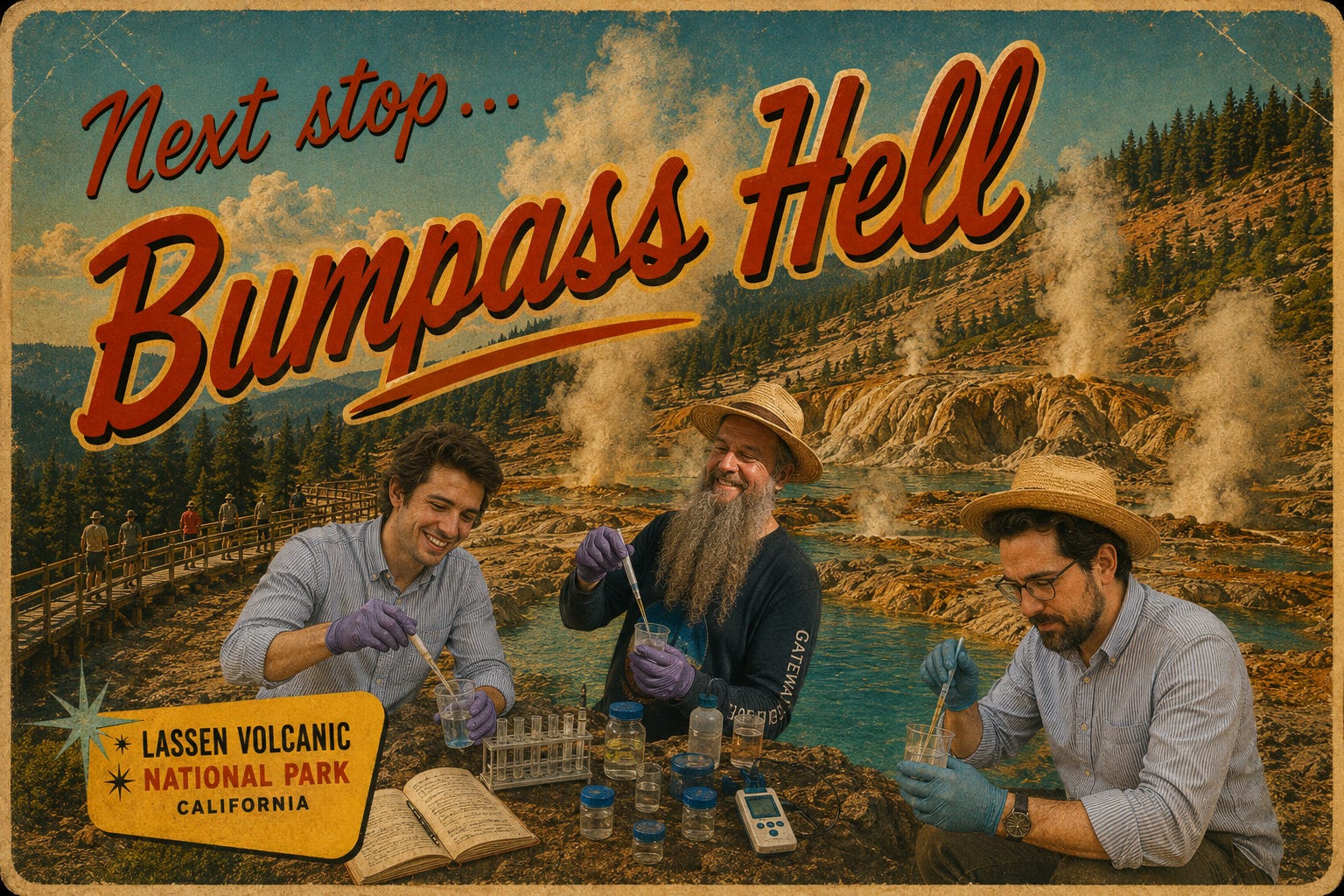
This weekend I’m packing the truck for a journey out to the aptly named Bumpass Hell (for Mr. Kendall Bumpass who lost his leg there in 1865) where we will be joined by two scientific colleagues and an intrepid film crew who will capture us trying to ‘grow protocells in the wild’. Protocells are tiny, cell-sized membranous sacs which could have formed from building blocks available on the lifeless early Earth, four billion years ago. These humble little units are widely considered by scientists to be a key starting point for life. In a process of wetting and drying, which happens a lot on volcanic hot springs as geysers pulse and vents steam forth, those protocells can also encapsulate polymers, formed when simpler molecules link up into long chains. At Bumpass Hell we will be testing whether RNA, a key polymer of life, can be synthesized in this way, and then become encapsulated into protocells.
We have carried out versions of this experiment before at the also aptly named Hells Gate in New Zealand, as well as in Iceland and Yellowstone National Park. Next week we will be throwing in a potential monkey wrench by adding some of ‘dirty’ elements to our vials. This dirt comes in two flavors: volcanic ash collected from a fresh eruption in Iceland, and ground up powder from a famous rock which fell from the sky back in 1969: the Murchison meteorite. The Murchison is famous because it contained all sorts of carbonaceous compounds, formed naturally in space during the time when the sun itself was igniting. Some of these materials include precursors to the building blocks of RNA and DNA, amino acids and amphiphilic organic compounds capable of assembling into membrane-like structures.
Stepping through a time portal
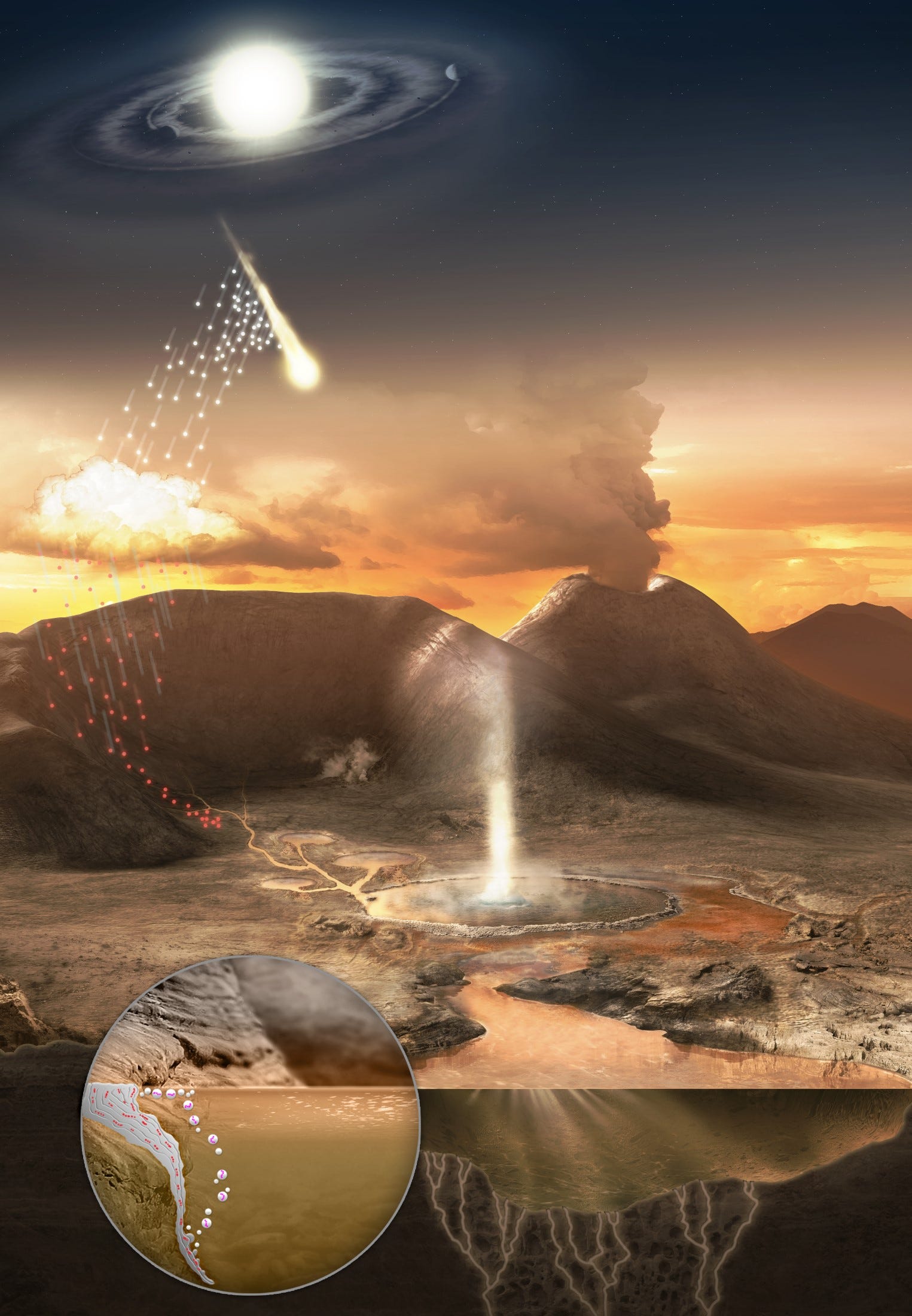
Picture the Earth four billion years ago. If you stepped through a time portal, you’d find yourself on a reddish-black volcanic landscape peppered with numerous hot spring systems, muddy lakes and rivers, and a distant green-brownish ocean. You’d have to be wearing all sorts of gear to keep you alive, protecting you against radiation, toxic gases, and above all, providing a supply of breathable oxygen as there was none to be found on this alien world. Coming upon a bubbling volcanic hydrothermal field situated on the flanks of a towering dormant volcano, you would notice all the different colors, temperatures and cycles of filling and draining. Active volcanos would be hurling ash into the sky and meteorites would be exploding with light flashes as they fell through our hazy atmosphere. Joining in the mayhem would have been almost invisible dust particles floating down from the disc around the sun. All of this gritty stuff would have been mixed and blown across the landscape, some of it landing in little hot spring pools, perhaps being cycled into something remarkable: the first living cells.
Taking origin-of-life chemistry out of the laboratory
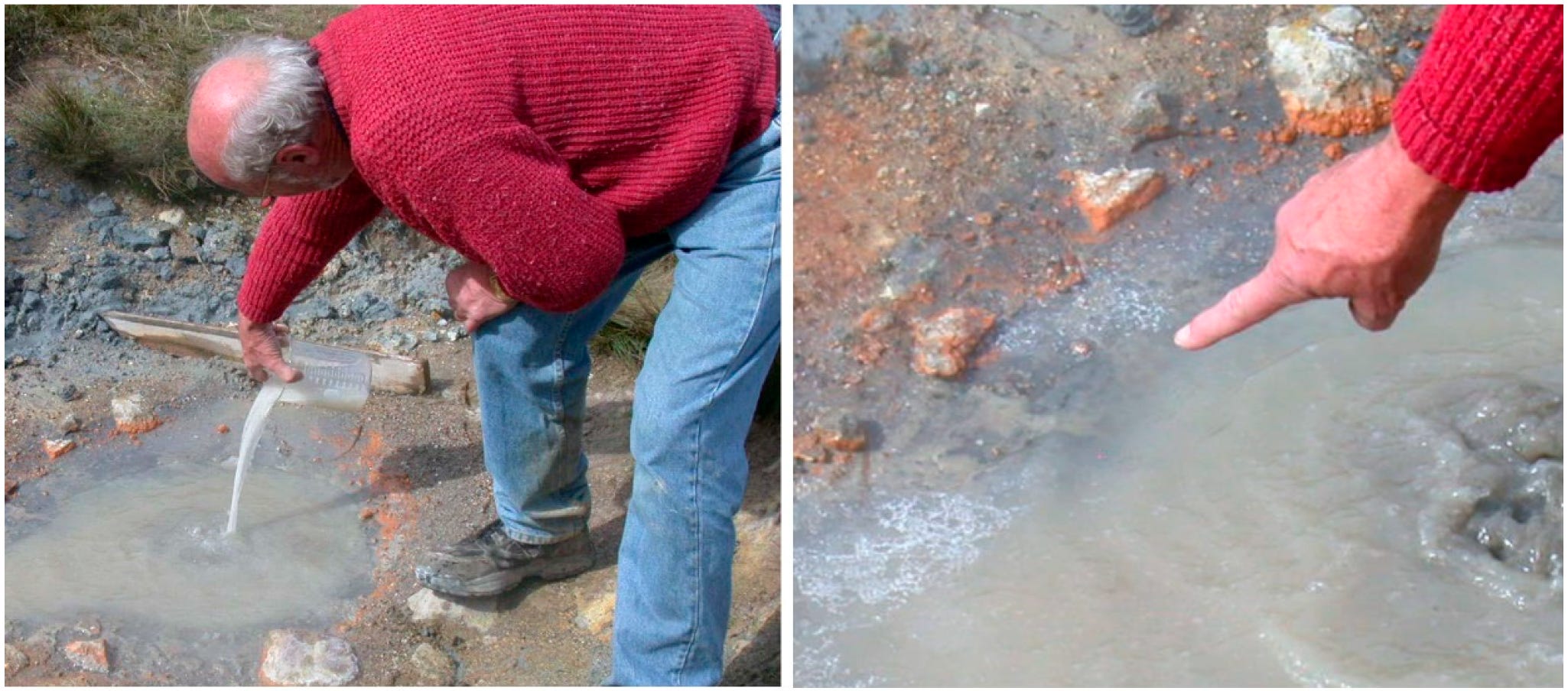
Analogues of these ancient environments still exist around the world today, and one of them is the Bumpass Hell hydrothermal field at Mt. Lassen Volcanic National Park just five hours drive north of us here in Santa Cruz, California. We will be donning protective gear, but thankfully won’t need an oxygen supply. With rangers standing by, we’ll step off the walkway and onto the crunchy hydrothermal ground. The first thing we will do is to look for water sources to drive our chemistry. We’ll first take a sample of clear hot spring outflow, and then extend a funnel and tube apparatus over a steaming fumarole vent, sending out hot, moist gases. Those gases will (hopefully) travel through the tube and condense on its walls, dripping out acidic water which we can use in our experiments.
We will then look for a suitable place to set down our chemical vials, housed in nifty aluminum heat blocks. We need to find a spot that can heat up our blocks to at least 60C (140F). One trick here is that we are at 8500 feet (2600 meters) so things will cool and dry quickly. The drying part is great, as it is through wet-dry cycling that we can form our wild-grown protocells. The cooling part is a potential problem so I am bringing along hot plates and a power bank in case we need to preheat our blocks.
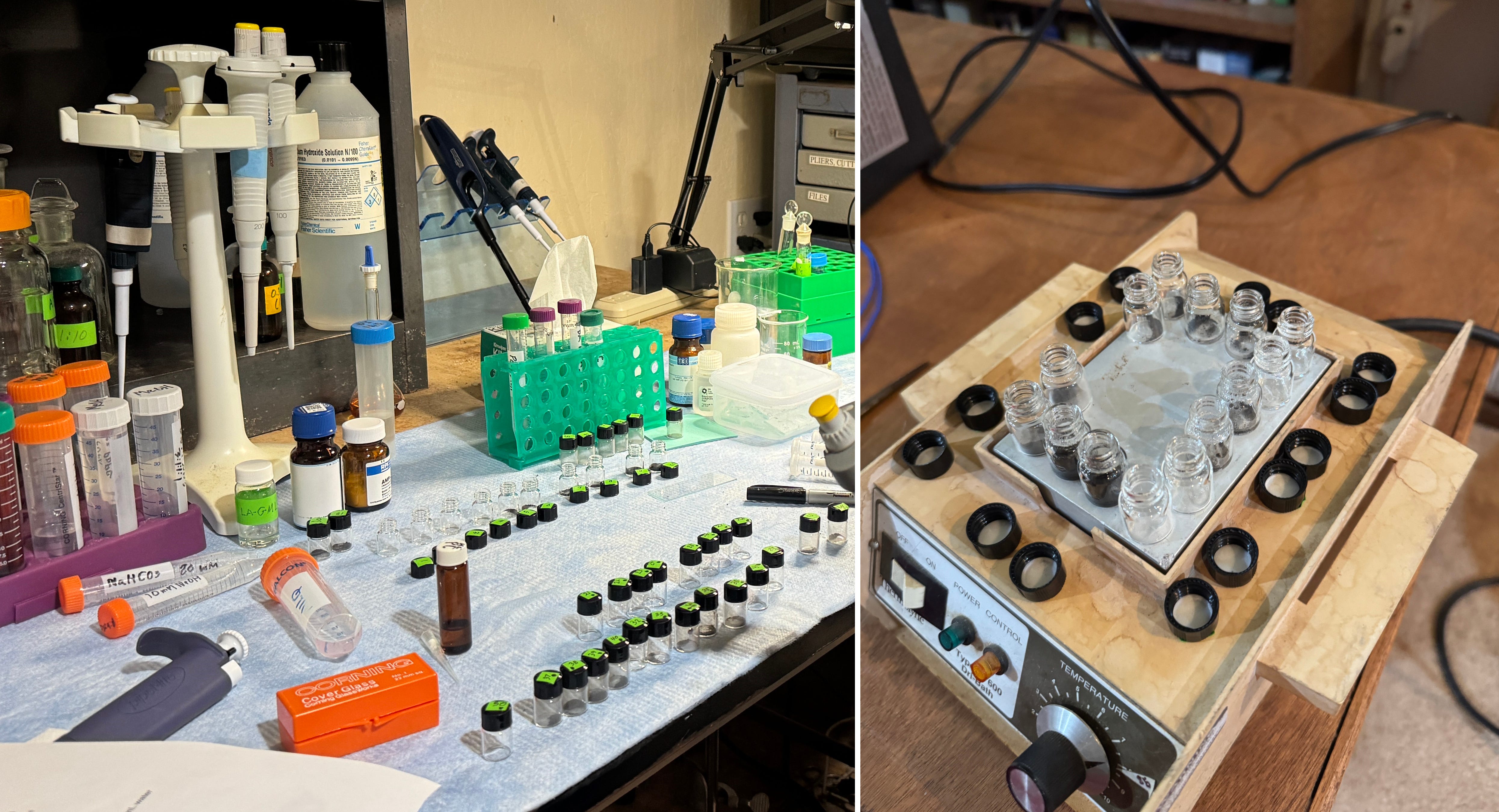
Once situated, we will start our cycling runs. Researcher Rafael Delwart and I will pipette 0.1ml (roughly a drop or two) into each vial, and leave it open to the air to dry. We expect the vials, which contain various mixtures of lipid, RNA building blocks, ash and meteorite powder, to dry down in about a half hour, after which time we will repeat a wetting cycle. All of this work has been reported in detail in a previous SubStack article OoL Part 1: A Progenitor for Life? If you want to geek out on the science, check out our key 2020 publication, the Hot Spring Hypothesis for an Origin of Life.
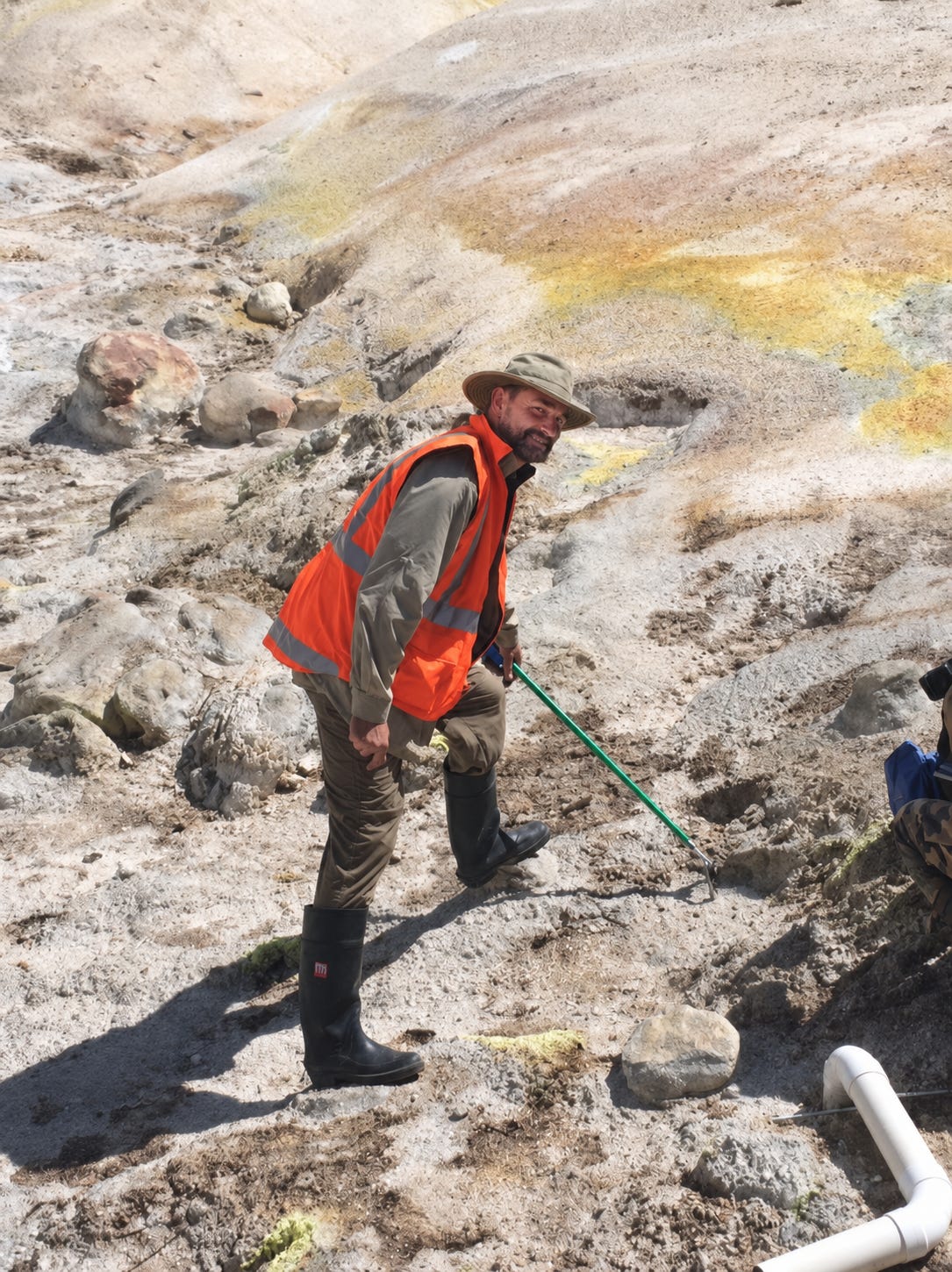
Our colleague Duhan Toparlak from Oxford University will be working alongside us using cyclophospholipids (quite a mouthful) supporting protocell formation and metabolism You can check out his recent article proposing how these compounds could have been key factors in an origin of life. We will be joined by Umbrella Films of Berlin, Germany who are shooting a fine documentary about the interconnectedness of life. Ten years ago this month I was at Bumpass Hell with my collaborator David Deamer where we carried out a prior version of these tests, and we were accompanied by another film crew. You can see this excerpt of us carrying out the science from their documentary Living Universe.
What do we hope to show?
Most of the time, we and our colleagues investigate chemical pathways that might have led to the origin of life under clean laboratory conditions, using purified water and chemicals ordered from catalogues.
Twenty years ago, Dave decided to visit Kamchatka in Russia’s Far East to try the chemistry directly in real, hot volcanic pool. He found that membranes, the building blocks of protocells, can form. This brave move (they had to carry guns because of the threat of grizzly bears) started a trend.

After all, Mother Nature could not order her chemicals from Sigma-Aldrich and there were no pipettes or vials handy on the ancient Earth, so she must have employed natural processes to do similar things. Hence all of these trips to ‘early Earth analog sites’ to test our chemical hypotheses in messy, and sometimes dangerous, natural primordial soups.
We therefore hope to show that we can still form protocells with some of the dirty stuff present, and using waters emerging directly from the ground. We are emphatically not attempting to start life again (an artificial biogenesis). What we hope to do is demonstrate to our colleagues that volcanic hydrothermal environments are good places to shine some light on one of science’s deepest unanswered questions:
How did orderly life emerge from a disorganized jumble of inanimate molecules?
From Bumpass Hell to Mars, and beyond
Looking farther afield, to Mars where surface rovers and orbiting spacecraft have identified hot spring minerals associated with ancient versions of Bumpass Hell. Such environments may therefore have represented potential urable zones, places possessing conditions and processes conducive to an origin of life, on the ancient Red Planet. Farther out, there must be countless planets circling other solar systems which also possess many of the properties of urability that we proposed in a 2022 paper introducing the term. Some of these worlds might have stared their own forms of cellular life, and a much smaller number might then have remained habitable long enough for complex, even thinking creatures to arise.
If we could eventually understand how often suitable planetary environments actually enable crossings of the threshold from nonlife to life, we might begin putting some empirical boundaries around one of the least constrained terms in the famous Drake equation: the fraction of worlds on which life actually begins. With that in hand, we can run the math again on what might be a very provisional account of (detectible) civilizations in our galaxy.
In a very real sense, our trek out to Bumpass Hell is connected to that age-old question:
Are we alone?

I’ll report back in a couple of weeks, once we’ve recovered ourselves and examined our samples in the lab.
We’re cautiously optimistic that we’ll “see” protocells down the barrel of our microscope, but if we don’t, this null result will help tune future experiments.
Astrobiologically yours,
Bruce
Well, passionate I'm looking forward to hearing all about your findings - does it, or doesn't it, hmmm.
Excellent (and peculiarly resonant, heh) article. I also want to encourage other readers to follow that "Living Universe" link. Good stuff!